

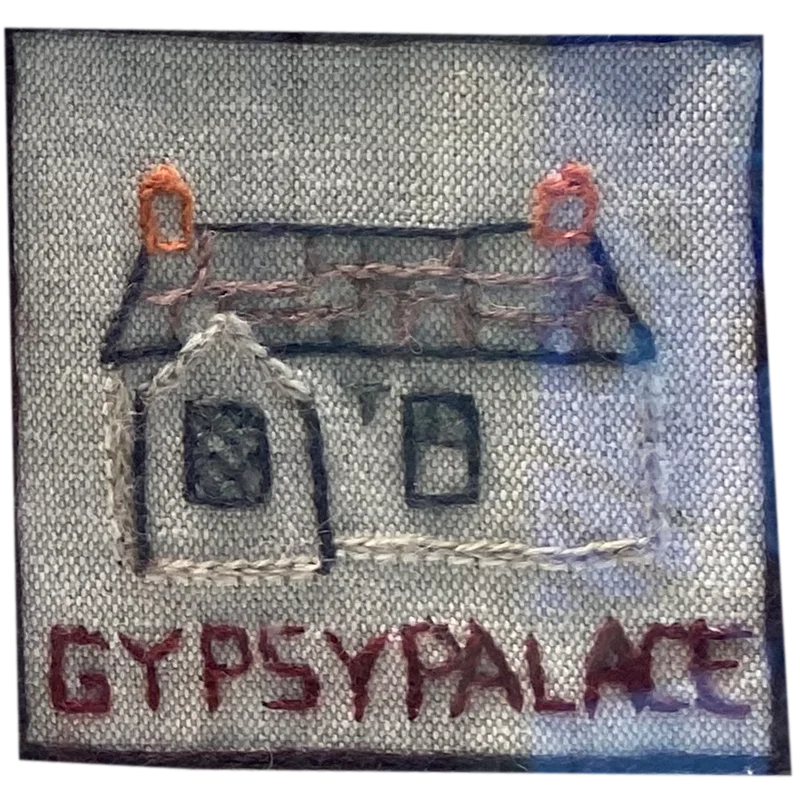
Gypsy Palace, Kirk Yetholm
- Artist: Helen Houston from Photography by Steve & Tracey Bloxham
- Stitcher: Serpil Renton
It seems likely that the building was first used as a gypsy dwelling in the 17th century. Queen Esther Faa Blythe, perhaps the most famous Gypsy monarch of all, took up residence on 16th November 1861. In August 1866, she was visited by George Burrow, a writer and Romany expert described Gypsy Palace as a ‘single storey, whitewashed thatched cottage with ivy covered walls’. The single room was relatively well furnished with two beds in recesses on either side of the fireplace, a chest of drawers, a clock, pictures and a cat’. Visitors, who came from all over the world to visit Queen Esther, claim to have seen two large swords hanging from the ceiling; one was the royal ceremonial gypsy sword and Queen Esther claimed the other was taken as a souvenir from the Battle of Flodden Field in 1513.
After Queen Esther’s death in 1883, the Gypsy Palace was renovated by local man, Peter Govanlock. It is probable the addition of the porch with its unusual arched window and the replacement of the thatched roof to slate was done at this time.
Queen Esther’s son, Charles Faa Blythe continued to live in the Palace. His coronation took place on 30th May 1898, a huge event with over 10,000 people descending on Kirk Yetholm. King Charles II, as he was known, continued to live in the Gypsy Palace until his death four years later.