

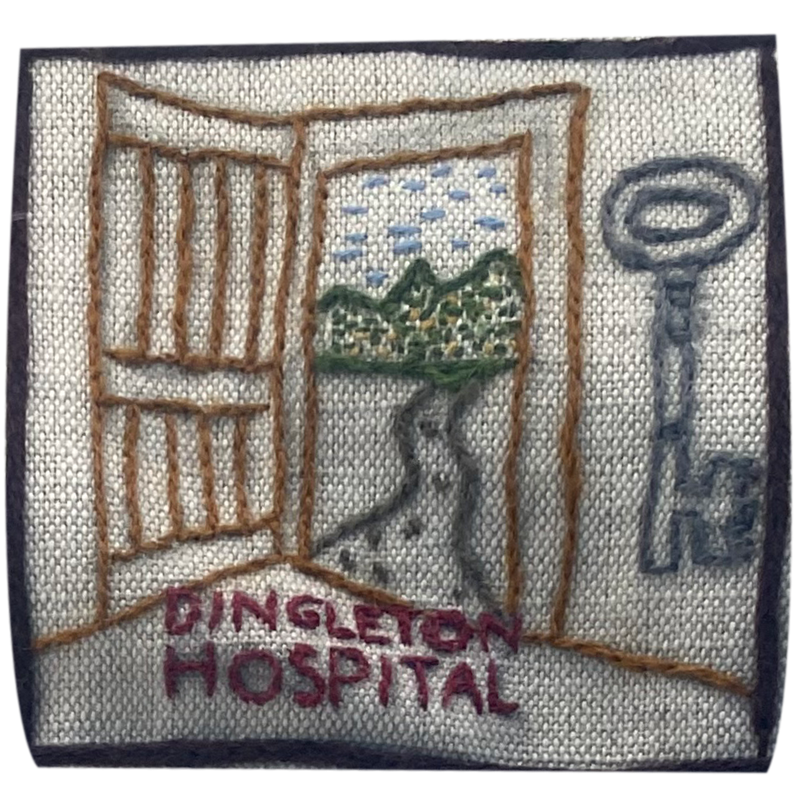
Dingleton
- Artist: Fiona Morris
- Stitcher: Veronica Ross
Dingleton Hospital opened in 1872 and closed in 2000. It was a pioneer of psychiatric care, quite remarkable for an institution set in a small town in the Scottish Borders, far from academia and the famous centres of medicine. As a result of this, Dingleton was a mix between the local and the international, attracting staff and visitors from all over the world, eager to see at first hand the innovative work being undertaken.
In 1949, Dingleton was the first psychiatric hospital in Britain to unlock all the doors. The phsician superintendent at the time, Dr George Bell, believed that isolation aggravated mental health problems. He said, “From the beginning, restraint and seclusion should be abolished, they are barbarous, inhuman, unnecessary and degrading to patients and staff alike”. The hospital chaplain at the time said, “Not prisoners, but free; not forgotten, but remembered; not unwanted but accepted; not hopeless but daring to dream the forgotten dream of a return to health”.
In 1962. Dr Bell retired and was replaced by Dr Maxwell Jones, who introduced anew approach to psychiatric treatment, the therapeutic community. This approach fundamentally changed thesocial structure of the hospital to one in which all staff and patients could participate in a democratic organisation, which provided open communications to all levels and in which authority could be openly questioned. There was more integration with the local community, more discharge of long-term patients. As a result of the hospital’s fame, many former Dingleton doctors moved on to leading positions throughout the world.
In 1967, Dingleton established a community psychiatric service, again well ahead of its time and acting as a role model for many other services. The community teams were multidisciplinary with doctors, nurses and social workers. On receipt of a referral, two members of the relevant geographic team would visit the patient in their own home. Increasingly patients were not admitted to hospital but received continuing home visits. Staff benefitted from having firsthand experience ofthe patient’s life and the patients benefitted because ti shifted the power balance so that they could feel more in control. The first Professor of Community Psychiatry in the UK was a former Dingleton doctor.